Sunday, May 15, 2011
Claim jumpers and carpetbaggers
I read a lot of history, but these are two terms I've known since I was about 8 years old. They both have to do with people who come in and try to take over what's yours. Since I have this blog I check to see where the traffic comes from. Looking recently at the "Stats" I found out that a certain search engine thinks it can just take over my -- and your -- pictures and post them. It leads over to my blog, but did they ever ask my permission? A couple times I have posted a detail of my paintings and I guess I will just have to do that in the future. I'm old fashioned and I just believe that what's mine is mine and doesn't belong to anyone else. You can read from my last post that I made nothing from a poster that's made thousands of dollars. I agreed to that, but I am a little unhappy about the rest. I just read an article about "exposure" and sales. "Exposure" doesn't put a dime in your pocket. Blogger beware.


Monday, May 9, 2011
The Waldorf Curriculum poster revisited

Every once in a while it happens -- it may be two or three years, but eventually someone somehow finds me and asks where they can get copies of the Curriculum poster that I did many years ago. I posted this and some of my chalk drawings that I did for the students as their lesson several years ago on this blog. (See my older entries, May, 2007) When I was in teacher training for the Waldorf School we were given an assignment to express the Curriculum in an artistic way --- what kind of artistic way was up to us. My son's dear teacher Ron Richardson gave that assignment to us. I thought about it and decided to do something that would be fun. I chose to have it resemble a board game, like Monopoly or Chutes and Ladders or Sorry. Done on an illustration board about 18 X 24 inches, I spent a good long time on it, including archetypal images from the curriculum and a few inside jokes along the way. Ron saw it and wanted me to give it to the school and have posters made. About 1500 posters were made. I never made a dime from it and it hangs in Waldorf schools and homes across the nation. As far as I can recall, I think I did this in 1995 or before. Anyhow, 16 years later I still get inquiries about it. Someone called up my signature of "Steve Johnson Construction Co." on the front as a Google search. I had intended to use that as a name for a career in illustration that never took off. At one time the teacher training powers that be asked me about teaching a class on blackboard drawing but their classes got smaller and it wasn't feasible. I did this with colored pencil and did many, many chalk drawings for the students' lessons which led me on to do pastels ---- so I guess that is my reward.
 to express the Curriculum in an artistic way --- what kind of artistic way was up to us. My son's dear teacher Ron Richardson gave that assignment to us. I thought about it and decided to do something that would be fun. I chose to have it resemble a board game, like Monopoly or Chutes and Ladders or Sorry. Done on an illustration board about 18 X 24 inches, I spent a good long time on it, including archetypal images from the curriculum and a few inside jokes along the way. Ron saw it and wanted me to give it to the school and have posters made. About 1500 posters were made. I never made a dime from it and it hangs in Waldorf schools and homes across the nation. As far as I can recall, I think I did this in 1995 or before. Anyhow, 16 years later I still get inquiries about it. Someone called up my signature of "Steve Johnson Construction Co." on the front as a Google search. I had intended to use that as a name for a career in illustration that never took off. At one time the teacher training powers that be asked me about teaching a class on blackboard drawing but their classes got smaller and it wasn't feasible. I did this with colored pencil and did many, many chalk drawings for the students' lessons which led me on to do pastels ---- so I guess that is my reward.
Wednesday, May 4, 2011
detail from "Farm at Honey Creek"

This is a detail that I took a few days ago, which has since been changed a bit. I liked this section -- about 5 X 7 inches as pictured here -- from a 20" X 30" oil painting which is now complete. Why? -- I liked the quality of the brushwork. I like doing layers of texture of grass upon grass or tree against the sky. I've had this up on the easel for several weeks, I think. I don't tend to remember dates and times exactly. But what I did have is something to look forward to, to contemplate while I was and when I was not working on it. Now that I have finished it I am rather bothered by that. Since I really liked working on it, it was something I looked forward to each day. I don't have my next idea waiting, so that's another reason I miss working on it. I'm sure everyone has some let down when a project is finished -- at least the ones they enjoyed. I've done plenty of things I wanted to run screaming out the door after they were done. This is another one of my Wisconsin farm paintings from a study along highway 20 in Honey Creek. Man, I love that area. This is waiting for the next Barns & Farms exhibition at a gallery near me.
Tuesday, April 26, 2011
Farm near Rochester, Wisconsin
 If this looks familiar, it should. I did a pastel of this same farm and posted it last year, June 2010. That was in a show called "Farms and Barns". I did this while teaching a small painting class. When I am not doing something for the class I have time to sit and work on something. Usually I don't like to repeat a painting I've already done, but I thought I'd like to do some pencil work. I intend to submit this to the next Farms and Barns show. Part of the motivation behind this comes from looking at the work of Clyde Aspevig, specifically his foregrounds. He seems to do a lot of detail work there and I thought I'd like to see what doing that would involve. Having done a lot of plein air painting I usually just finish off a foreground with a few thick brushstrokes and some indications of sticks or grasses. Here I went in and noodled out some of the plant life at the side of the road and spent a lot longer on it than I am used to. I liked the results --- thanks, Clyde. Next up is "Waterworks" a show of watercolor paintings, a group show with other people who take classes with Ed Hinkley. I am doing the show even though I am the oddball -- I paint quite realistically; portraits and landscapes. I don't do the show every year ---- reason, I just haven't sold well there, so I will just have to have my wine and cheese and see what happens. Show is at August House Gallery in Chicago on Roscoe 2 streets west of Damen, beginning May 1st, 1 to 5 pm.
Monday, April 18, 2011
Secret Life of the Artist, part 4

Here is an image of my wood turning work. Part of my official/unofficial "Secret Life of the Artist" series, I know there are plenty of artists out there who do all kinds of things besides oil, watercolor and pastel and are quite good at them. Out of my training in the Navy and in art school, I felt that there just isn't anything out there that I can't do well or learn to do well. In the Navy I worked with tools setting up aircraft parts racks, shot a pistol quite well and did a lot of out of the ordinary non-art things. If you're an oil painter and you do that better than anything why should that ever be a limitation on doing anything else well? Anyhow, I was in Brasstown, North Carolina -- possum country -- last week with my wife, a quilter. I took a week long class on wood turning. The picture you see has two bowls turned from cherry wood and a tool with a handle turned from red oak. They were some of the projects I did over that week. I was never really trained much in the industrial arts --- apologies to Mr. Joe Polka who tried to teach us 7th and 8th graders at Garvy Elementary School how to do a few things with tools. Man, that poor guy -- never did I see a more nervous teacher than he was. Imagine trusting 12 and 13 year old boys with tools and grinding machines and saws. He was a chain smoker and a guy who never smiled. I can see why. Instead of doing art this year at the John C. Campbell Folk School, I thought I'd try something different. It was hard to do, but I gave wood turning a try and I did some nice work. That's the point of my little series: artists have the ability to handle quite a large range of skills, even in unexpected areas. We all have all kinds of things we do to make money or hobby type things we do and do well that are outside the focus of our main theme of art. Have faith in yourself and give it your best shot.
Thursday, April 7, 2011
Portrait in watercolor

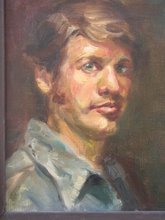
This is an 8" X 10" portrait on cold press Arches paper in watercolor. Done about a year ago I no longer remember where I found the reference. I will be doing the Waterworks show this year in Chicago at August House Gallery. I have two framed and 6 unframed watercolors in the show. When I work in oil, I am not particularly fussy about the surface. I often just work on a canvas panel for my plein air work, but in the studio I stretch my own canvas or linen and gesso the surface with some texture. However, when it comes to watercolor paper, hot press is too smooth for me and rough is nice, but cold press just right; kind of like the story of the three bears.
Sunday, April 3, 2011
Familiar ground -- Fire's Creek
 This is another view of the bridge at Fire's creek in North Carolina --- well, there's two that I know about. I did an oil from near this spot, this is a pastel, 7" X 11". Usually I don't do a painting over and over, but the area around there is so rich with material for a painting that I find new things all the time. I live in the city, but don't relish painting it. Maybe if I came here from Brasstown, NC, I would be fascinated at all the things there are to paint here. I suppose, like a painter friend of mine said, it's romanticising the nature aspect of the wilderness by hauling your painting gear up into the woods or mountains or an old farm site. That being the case....I was taken by the incoming sunlight and colors of the scene, the sparkle on the water and the trees at the right. And to answer your question.....the "white" areas are not snow, but mud. The low incoming light glanced off the wet mud and rocks and made it look white. I hope I threw in enough other warm and cool off-white colors (that's "colour" to all the UK readers) to define that a little better. I worked on this during down time teaching at my art class on Tuesday night.
Subscribe to:
Posts (Atom)